Why I Stopped Trusting Coffee Labels and Started Brewing My Own Perfect Cup
Why I Stopped Trusting Coffee Labels and Started Brewing My Own Perfect Cup
I used to blame myself for the way coffee made me feel.
The jitters. The stomach cramps. The acid reflux that hit like clockwork thirty minutes after my morning cup. I figured I was just sensitive to caffeine. Maybe coffee wasn't for me.
Then I tried decaf.
Same problems. Same digestive chaos. Same anxious feeling creeping through my chest. That's when I stopped blaming my body and started questioning the coffee itself.
The Moment Everything Changed
I gave up coffee entirely for a while. Switched to tea. The symptoms disappeared almost immediately.
But I missed coffee. Not the burnt, bitter sludge I'd been drinking—I missed what I thought coffee could be. So I started investigating.
What I discovered made me realize I'd never actually tasted real coffee. I'd been drinking stale, chemically processed beans that had been sitting in warehouses for months, losing flavor and accumulating oxidation damage with every passing day.
The coffee industry had been lying to me. And I was ready to find out what I'd been missing.
My First Taste of What Coffee Actually Is
I ordered a single-origin coffee from Mexico. Freshly roasted. Shipped within days of roasting.
The first sip stopped me cold.
Light fruit flavors. Brightness. Clarity. A complexity I didn't know coffee could have. This wasn't just "better coffee"—it was a completely different beverage than what I'd been drinking my entire life.
I started with an AeroPress. The coffee was good, but something felt muted. The flavors were there, but they felt muddy, like I was tasting them through a filter of heaviness.
That's when I discovered pour-over brewing.
Why Pour-Over Changed Everything
Pour-over uses percolation. Fresh water continuously flows through the coffee bed, constantly extracting new compounds. It's fundamentally different from immersion methods like AeroPress or French press, where all the grounds sit in all the water at once.
When I brewed that same Mexican coffee as a pour-over, florals emerged. Chocolate notes. Dried fruit. A black tea-like quality with citrus berry acidity that had been completely buried in my AeroPress brews.
The difference wasn't subtle. It was dramatic.
I realized I'd been extracting coffee wrong this whole time. And if the brewing method mattered this much, what else was I missing?
The Variables That Actually Matter
I became obsessed with three things: grind size, water temperature, and pouring technique.
Grind size controls extraction speed. Water temperature affects which compounds dissolve. But pouring technique turned out to be the precision tool that unlocked everything else.
I learned this the hard way.
The Pour That Taught Me Everything
I was using a regular kettle. No gooseneck spout. No control over water flow.
I poured too fast. Too aggressively. The water dug channels through the coffee bed, racing through some areas while barely touching others.
The result? A cup that was simultaneously bitter and sour. Over-extracted in some spots, under-extracted in others. Burnt, ashy aftertaste. Completely unbalanced.
That failure taught me what success couldn't: uneven pouring creates channeling, where water finds paths of least resistance instead of flowing evenly through all the grounds.
I bought a gooseneck kettle the next day.
How to Diagnose What's Going Wrong
Before I understood channeling, I only judged my brews by taste. But taste alone doesn't tell you where in your technique things went wrong.
The visual clue I was missing? The grounds bed after brewing.
A well-extracted pour-over leaves a flat, even bed of grounds. If it's mountainous or uneven, water channeled through too quickly in some areas. Those mounds are evidence of extraction problems you can't see while brewing.
Once I knew to look for this, I could diagnose my technique in real time. Adjust pour height. Change pour rate. Experiment with circular versus center pours.
Each variable shifted the flavor profile without changing the coffee or grind size. That's when I realized just how precise this process could be.
The Health Connection I Wasn't Expecting
I was chasing flavor. But I stumbled into something bigger.
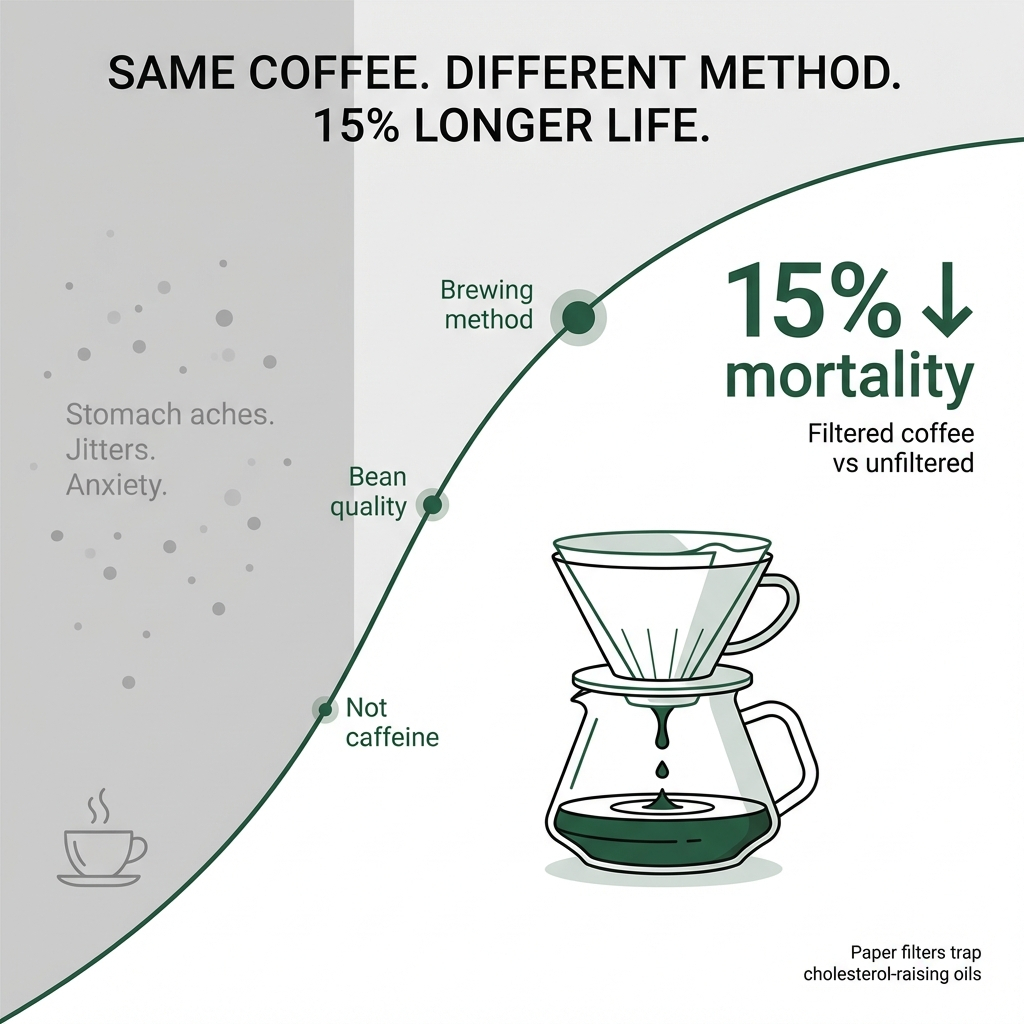
Research shows that filtered coffee consumption is associated with 15% lower all-cause mortality compared to no coffee. Unfiltered coffee? No significant benefit.
The brewing method matters more than most people realize.
Here's why: Unfiltered methods like French press and espresso allow diterpenes—oily compounds called cafestol and kahweol—to pass into your cup. These compounds are among the most potent cholesterol-raising substances in the human diet.
A dose of just 10 mg of cafestol daily for four weeks increases serum cholesterol by 8-10%. Replacing three cups of unfiltered coffee with paper-filtered coffee could reduce LDL cholesterol by 0.58 mmol/L.
That "muddy" flavor I was getting from the AeroPress? I was literally tasting those cholesterol-raising oils.
Paper filters trap diterpenes while allowing beneficial polyphenols and antioxidants through. Pour-over gives you the health benefits without the cardiovascular risk.
The Freshness Deception
Once I understood brewing technique, I had to confront the elephant in the room: bean freshness.
Those "best by" dates on coffee bags? They're meaningless.
Ground coffee loses up to 60% of its aromatics within the first few hours after grinding. Whole beans lose up to 70% of their aromatic compounds within the first few weeks after roasting.
Coffee peaks between 7-21 days after roasting. Before that window, beans are too gassy and produce unstable extraction. After three weeks, oxidation has degraded the volatile compounds responsible for complex flavors.
World Barista Championship competitors use coffee 5-14 days off roast. Never day one. Never three months old.
When you buy grocery store coffee with a "best by" date six months out, you're getting beans that might be 3-6 months post-roast. Technically safe. Taste-wise, completely dead.
The loss of aroma roughly doubles every 10°C increase in temperature. Those beans sitting in warm warehouses or on sunny store shelves? They're losing their magic long before they reach your kitchen.
What You Actually Need
After dozens of failed brews and countless experiments, here's what matters:
Essential equipment:
A gooseneck kettle for controlled pouring
A burr grinder for consistent particle size
A pour-over dripper (V60, Chemex, or similar)
Paper filters to trap diterpenes
A scale for precise measurements
Critical technique points:
Use 60 grams of coffee per liter of water for pour-over
Grind immediately before brewing
Pour slowly and steadily from low height
Aim for a flat grounds bed after brewing
Practice pouring without coffee grounds first to build muscle memory
Sourcing strategy:
Buy beans with a roast date, not just a "best by" date
Use beans within 7-21 days of roasting
Store in an airtight container away from light and heat
Buy only what you'll use in 2-3 weeks
How Many Bad Cups Does It Take?
I made dozens of terrible brews before I had my first consistently good one.
Each failure taught me something taste alone couldn't reveal. The burnt, bitter cup from pouring too fast. The sour, weak brew from channeling. The muddy extraction from inconsistent grind size.
Practicing pouring technique without coffee grounds—just water and an empty dripper—built the muscle memory I needed. It's like a musician practicing scales. Boring. Repetitive. Essential.
The moment I finally thought "okay, I've actually figured this out" came when I could predict how a coffee would taste based on how the pour felt and how the grounds looked afterward.
That's when brewing stopped being guesswork and became a craft I could control.
What This Really Means
This isn't just about making better coffee.
It's about questioning what we've been told is "good enough." About understanding that convenience often comes at the cost of quality and health. About realizing that the things we consume daily deserve more attention than we give them.
The coffee industry shifted from agriculture to chemistry decades ago. They use industrial extraction methods to pull every last compound from cheap beans, creating concentrated chemical extracts rather than natural beverages.
They mask defects with high-temperature roasting that burns away nuance. They package months-old beans with meaningless dates. They tell us bitter and burnt equals strong and bold.
And we believed them because we didn't know any better.
Now I know what coffee actually tastes like. What it can do for my health when brewed properly. How much control I have over the final cup.
The difference between commercial coffee and freshly roasted, properly brewed pour-over isn't incremental. It's transformative.
You just have to be willing to question what you've been drinking all along.
Start Here
If you want to try this yourself, start simple:
Find a local roaster or online source that lists roast dates. Order a small bag of single-origin coffee. Get a gooseneck kettle and a basic pour-over dripper.
Grind the beans immediately before brewing. Pour slowly and steadily. Watch the grounds bed after brewing.
Your first few attempts will probably be terrible. That's normal. Each bad cup teaches you something.
But when you finally taste what coffee can be—bright, complex, clean, beneficial—you'll understand why I stopped trusting labels and started brewing my own perfect cup.
You can't go back once you know the difference.