
Choosing Your Coffee Grinder: A Technical Comparison Guide
Choosing Your Coffee Grinder: A Technical Comparison Guide
Your coffee grinder determines extraction quality before water touches grounds. The grinding mechanism—blade, conical burr, or flat burr—fundamentally alters particle size distribution, which controls how water flows through coffee and extracts flavor compounds.
Understanding these mechanical differences enables you to match grinder technology to your brewing method and quality expectations.
The Mechanics Behind Grinding Methods
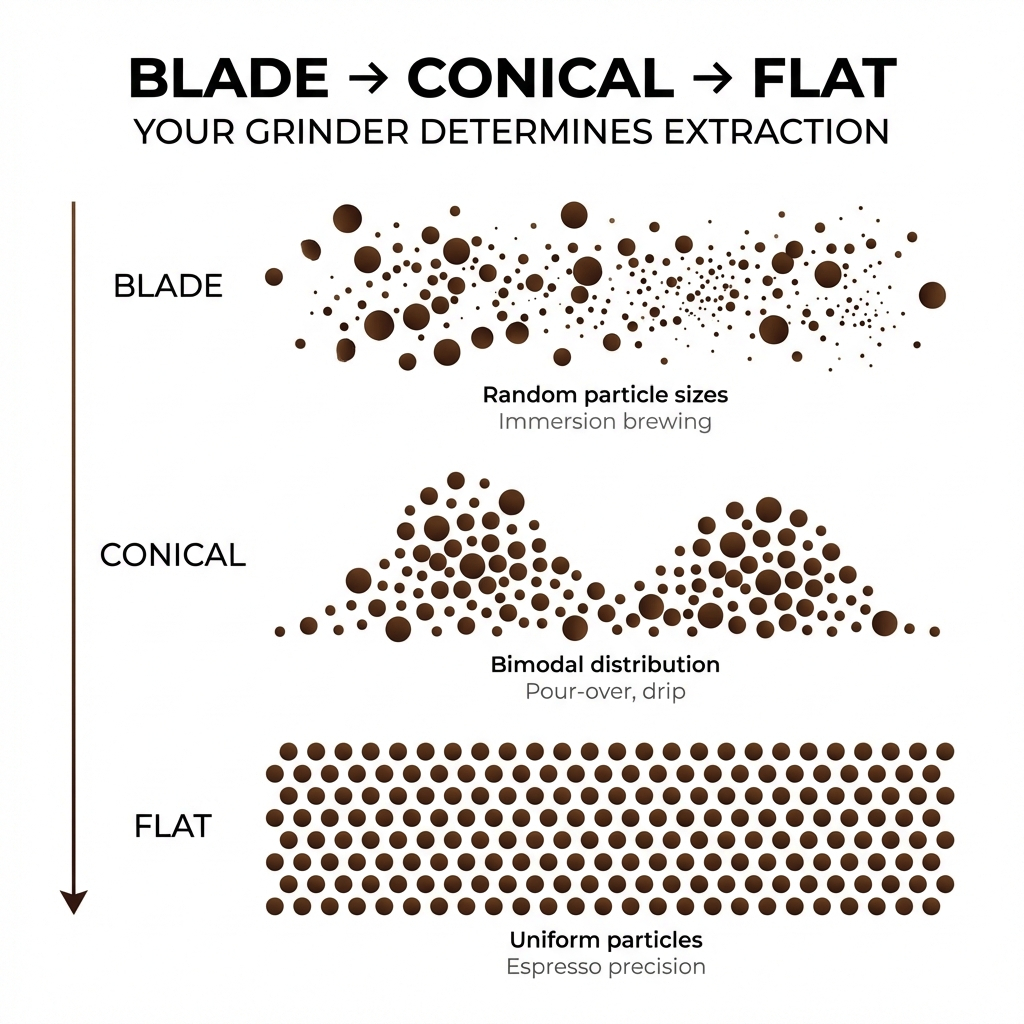
Blade grinders use rapidly spinning blades that chop beans randomly, similar to a blender. This impact-based mechanism produces a wide range of particle sizes—from fine powder to large chunks—in a single grinding session.
The repeated blade contact generates significant friction. High-speed blade grinders can spike chamber temperatures enough to vaporize delicate aromatic compounds before they reach water.
Burr grinders operate differently. They crush beans between two abrasive surfaces using pressure and shearing forces. This crushing action produces more uniform particles while generating less heat.
Conical burrs feature a cone-shaped center burr nested inside a ring burr. Gravity assists bean feeding, and the vertical position allows grounds to exit through the bottom with minimal retention.
Flat burrs position two parallel discs horizontally. Beans enter from above and exit from the sides after being crushed between the burr surfaces. This configuration requires more motor power but produces the most uniform particle distribution.
Temperature Control and Aroma Preservation
Aroma compounds in coffee beans begin degrading at approximately 280°F (138°C). Blade grinders can reach these temperatures through repeated impact and friction, essentially pre-cooking volatile aromatic molecules.
Burr grinders maintain cooler grinding temperatures through controlled crushing action. Even cold grinders produce grinds about 18°F warmer than the beans due to friction, but burr systems minimize this heat buildup.
Commercial grinders can experience temperature increases of 20-30°F during continuous operation. Flat burrs typically generate more heat than conical designs due to larger contact surface area, though larger burr sizes (64mm versus 50mm) require fewer rotations and produce less heat overall.
Particle Distribution and Extraction Dynamics
Particle size distribution determines extraction evenness. Coffee ground for espresso exhibits a characteristically bimodal distribution—two distinct peaks in the particle size graph.
Conical burrs produce a wider bimodal distribution. This means more variation between the smallest particles (fines) and larger chunks. The range creates a natural extraction buffer: fines extract quickly, contributing brightness and body, while coarser particles extract slowly, adding depth and texture.
This distribution makes conical burrs forgiving for pour-over brewing. The mix of particle sizes balances extraction dynamics naturally, compensating for slight variations in grind settings or brewing technique.
Flat burrs produce a narrow, uniform distribution. The ideal espresso particle distribution features approximately 70-80% of particles falling within the 200-800 micron range. This uniformity promotes even extraction but demands precise control—small deviations in grind size cause noticeable flavor changes.
Why Immersion Brewing Tolerates Inconsistency
French press brewing demonstrates why grind consistency matters differently across brewing methods.
In immersion brewing, grounds steep in water for the entire brew time (typically 4 minutes). Water extracts flavors from all particles regardless of size. The extended contact time allows even uneven particles to extract adequately.
Coffee grounds naturally stratify during steeping. Fines settle to the bottom while larger particles float near the surface, creating a self-filtering effect that reduces the number of fines passing through the plunger mesh.
Pressure-based methods operate under different constraints. Espresso forces water through a tightly packed coffee bed in 20-30 seconds under 9 bars of pressure. This short extraction window requires uniform particle sizes to ensure even water flow.
The Particle Packing Problem in Espresso
Fines create specific problems in espresso through particle packing dynamics.
When you compress coffee grounds into an espresso puck, fines fill gaps between larger particles. This creates a dense, low-permeability bed that restricts water flow and increases resistance.
The problem intensifies because fines compress more easily than larger particles. This creates uneven density within the puck—some areas pack tighter than others. Water finds paths of least resistance, a phenomenon called channeling.
Channeling causes simultaneous over-extraction and under-extraction. Water rushing through channels over-extracts those areas (bitter flavors) while bypassing denser regions entirely (sour, underdeveloped flavors).
Flat burrs address this through particle uniformity. Fewer fines and more consistent particle shapes pack more predictably. The puck maintains consistent density, promoting even water flow and balanced extraction.
Conical burrs produce more fines and irregular particle shapes. This creates less uniform packing and increases channeling risk, requiring more precise dialing to achieve consistent shot quality.
Matching Grinder Technology to Your Brewing Method
Your brewing method determines which grinder characteristics matter most.
For French press and cold brew: Blade grinders suffice for many users. The forgiving nature of immersion brewing masks grind inconsistency. However, you'll notice improved clarity and reduced sediment with burr grinders.
For pour-over: Conical burr grinders offer the best balance. The bimodal distribution creates forgiving extraction with fuller body and texture. You gain consistency without demanding perfect dialing.
For espresso: Flat burr grinders provide the precision required. The narrow particle distribution reduces channeling and enables repeatable shot quality. The investment pays dividends in consistency and flavor clarity.
Performance Metrics Beyond Particle Size
Retention rate affects dose accuracy and flavor consistency. Conical burrs have lower retention thanks to gravity-assisted vertical positioning. Flat burrs retain more grounds due to horizontal mounting and side-exit design.
Motor speed influences heat generation. High-torque, low-speed motors (400-600 RPM) apply crushing force efficiently with minimal friction. High-speed grinders (1000+ RPM) generate 2-3 times more heat than low-speed alternatives.
Burr size matters for heat management. Larger burrs grind the same amount with fewer rotations, reducing heat buildup. A 64mm burr set generates less heat than a 50mm set when grinding identical doses.
Implementation Considerations
Adjustment capability varies significantly. Stepped grinders offer preset positions—reliable but potentially limiting. Stepless grinders provide infinite adjustment—maximum flexibility but requiring more skill to dial in precisely.
Maintenance requirements differ by design. Conical burrs typically last longer before requiring replacement. Flat burrs may need replacement sooner but often deliver more consistent performance throughout their lifespan.
Budget constraints influence practical choices. Quality conical burr grinders start around $100-150. Professional-grade flat burr grinders typically begin at $300-400. Blade grinders cost $15-30 but sacrifice extraction quality.
Making Your Decision
Start with your primary brewing method. Espresso demands precision—invest in flat burrs. Pour-over and drip benefit from conical burrs' forgiving consistency. French press and cold brew work acceptably with blade grinders, though burr grinders improve results.
Consider your volume requirements. If you grind multiple doses daily, prioritize low retention and efficient heat management. Single-dose grinding minimizes retention concerns.
Evaluate your tolerance for dialing. Flat burrs reward precision with clarity but punish inconsistency. Conical burrs forgive minor variations while delivering satisfying results.
Your grinder selection determines extraction potential before you begin brewing. Understanding the mechanical principles behind each technology enables informed decisions aligned with your specific needs and quality expectations.